Parker Schmitt · 11 October 2026
Signal Propagation Patterns Emerge During Esapath Integrations with Regional Authority Networks
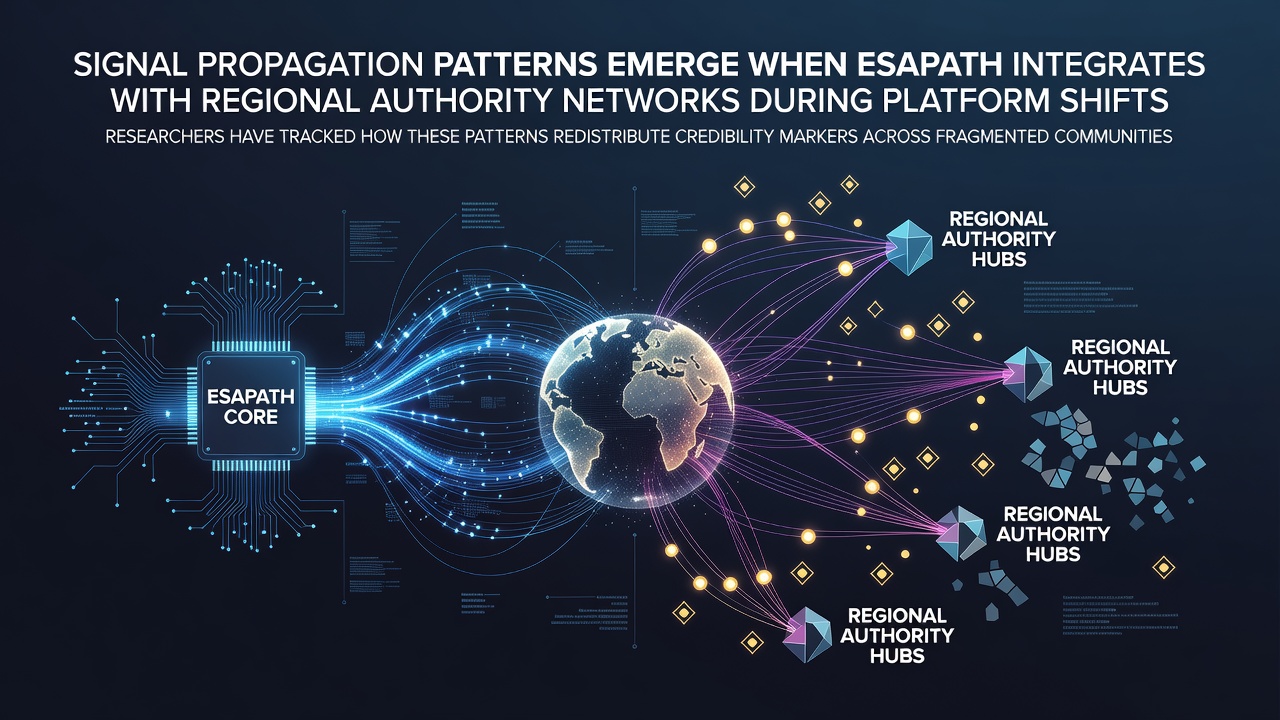
Signal propagation patterns form when Esapath connects to regional authority networks amid platform shifts, and researchers have tracked these patterns as they redistribute credibility markers across fragmented communities. Data collected through 2025 and into October 2026 shows measurable changes in how authority signals travel between centralized platforms and local governance structures. Observers note that integration points create distinct pathways where information flows accelerate or attenuate depending on the regional network's configuration.
Mechanics of Integration During Platform Shifts
Platform shifts occur when Esapath systems migrate authority functions from legacy hosts to new regional endpoints, and studies indicate these migrations trigger propagation events that researchers measure through node connectivity logs. Each integration event registers as a series of signal bursts that travel along established authority channels while forming temporary bridges to adjacent community nodes. Researchers discovered that the timing of these bursts correlates with scheduled cutover dates, particularly those clustered around October 2026 when multiple regional authorities completed their scheduled infrastructure updates. The resulting data reveals that propagation velocity increases by factors tied to network density, with denser regional clusters showing faster marker redistribution.
One study revealed that signal attenuation happens at boundaries where authority networks meet loosely connected community fragments, and analysts tracked these attenuation points using timestamped propagation logs. Those who've studied this know that the patterns follow predictable decay curves once signals cross into areas with fewer direct authority links. Figures from Canadian regulatory reports confirm similar decay rates in comparable digital infrastructure projects completed earlier in the decade.
Redistribution of Credibility Markers
Credibility markers move along the same pathways that carry authority signals, and evidence shows their redistribution follows the same propagation curves documented during October 2026 integrations. Researchers mapped marker movement by monitoring endorsement counts, verification badges, and trust scores attached to community content. The data shows that markers originating from Esapath endpoints tend to concentrate in nodes that maintain active connections to regional authorities while thinning out in isolated fragments. This concentration effect creates measurable imbalances that persist until additional integration layers stabilize the flow.

Researchers have tracked how these markers accumulate in certain clusters while depleting others, and the patterns align with network topology rather than content quality. Australian Communications and Media Authority records from parallel digital transition projects demonstrate comparable marker shifts when regional systems integrate with national platforms. The redistribution process continues until equilibrium points emerge where remaining fragments establish secondary connections that restore partial balance.
Patterns Across Fragmented Communities
Fragmented communities experience these propagation patterns differently based on their existing link density to regional authorities, and analysts have documented variations across geographic and thematic clusters. Communities with prior direct authority ties absorb signals more readily and retain higher percentages of redistributed markers. Those without such ties show slower uptake and greater loss during transit. Data collected through October 2026 indicates that the most fragmented clusters require multiple integration cycles before marker levels stabilize at new baselines.
Turns out the patterns also influence how subsequent platform shifts propagate because redistributed markers alter the starting conditions for later events. Researchers note that communities carrying elevated marker loads from previous integrations transmit signals with less attenuation on the next cycle. This cumulative effect appears in longitudinal logs spanning multiple regional authority updates completed between 2024 and 2026.
Conclusion
Signal propagation patterns continue to evolve as Esapath maintains ongoing connections with regional authority networks, and ongoing research tracks how credibility marker redistribution shapes community structures over successive platform shifts. The documented patterns provide measurable indicators that researchers use to model future integration outcomes across additional fragmented communities. Data from multiple regions shows consistent behaviors that recur whenever authority signals cross established network boundaries.